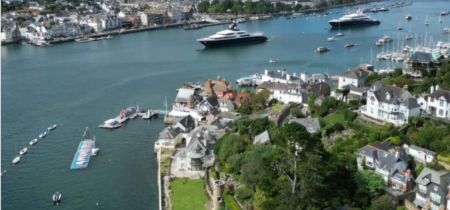
The Dart Harbour and Navigation Authority was formed in 1975 by the amalgamation of the River Dart Navigation Commission and the Dart Harbour Commission. In 2007, the shortened name “Dart Harbour” was adopted for everyday use.
The Duke of Somerset, with the aid of an act of parliament, created the River Dart Navigation Commission to improve the river’s navigation while entrepreneur Charles Seale Hayne used the opportunities opened up by the coming of the railway to attract money to improve and upgrade the port’s facilities. He formed the Dart Harbour Commission to promote and encourage shipping, including building or maintaining quays, providing buoys, lights or beacons.
The local economy was boosted even more when, in 1863, the Royal Navy decided to train naval cadets on the Dart and stationed first the Britannia, then the Hindustan, in the river at Mount Boone – on the estate of Sir Walter Raleigh. In 1905, the architect Sir George Aston Webb was commissioned to design the Navel College seen at Dartmouth today.
In 1975, when Dart Harbour was formed, 75% of the activities on the river were commercial and 25% leisure. Today that figure has more than reversed and is 95% leisure and 5% commercial. Dart Harbour has embraced these changes by sympathetically increasing the number of available moorings and establishing anchorages in Dartmouth and in the quieter areas upriver.