You are here: Dart Harbour » Harbour & River Guide » Sailing Directions
Sailing Directions
Introduction
The following directions are intended as a helpful description of your journey up river. They do not relieve master and skippers of vessels of their obligation to conduct their own safe pilotage plans within harbour limits.
In the entrance, the stream ebb or flow seldom exceeds 2 knots except after heavy rainfall or strong northerly winds when, on the ebb tide, this can run up to 3.5 knots.
At spring tides, the river almost dries out for two miles below Totnes at low water, but vessels drawing not more than 0.9m (3 feet) can proceed to Totnes 1.5 hours after low water.
Dartmouth CastleThe tidal stream 1.5 miles outside the entrance runs N.E. from 2 hours before to 4 hours after high water at Dartmouth and S.W. from 2 hours before to 4 hours after low water at Dartmouth.
To make the best use of this guide, reference should be made to Admiralty Chart No 2253 (Edition No. 6. 13/12/2012) or a suitably detailed and up to date equivalent.
Most Harbour Authority mooring buoys are blue. Those designated for visitors are marked with a black “V”. Visitors’ pontoons and visitors’ dinghy moorings are marked with blue flags. There are no formal visitors’ landing points south of the Lower Ferry.
CAUTION
Keep a good look out for the two lower car ferries that ply between Kingswear and Dartmouth – they comprise a tug and vehicle-carrying float that is towed alongside the tug. They are restricted in their ability to manoeuvre and exhibit appropriate shapes/lights. The wire guided Higher Ferry that crosses the river just below Dart Marina exhibits the same shapes/lights. Beware of submerged wires in the vicinity of this ferry. See also Notice to Mariners for information on speed limits, diving and other information.
Entry to Harbour from Sea
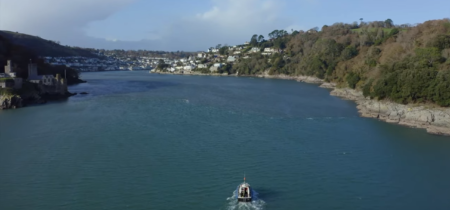
The Daymark Beacon is a 24m high stone tower. This marks the eastern side of the entrance to the River Dart. It is maintained by Dart Harbour.
Daymark and Harbour Entrance
Homestone Buoy (Port Lateral) Q.R marks the Homestone Ledge. Castle Ledge Buoy (Starboard Lateral), FI G.5s, marks the extremity of the Castle Ledge. Mariners without local knowledge should not pass between the Castle Ledge Buoy and the shore.
Lighthouse and River Mouth
Keep Kingswear lighthouse, a sectored light (small white structure) ISO.WRG.3s 9m 8M, in line with the right hand edge of the large white house above the lighthouse. This will keep you in the middle of the channel. At night keep in the white sector of the light. Leave the Checkstone Buoy (Port Lateral), Fl (2) R.5s, to port.
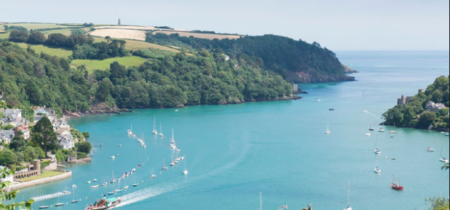
Follow the course of the river keeping to starboard of the river centre. South of the Lower Ferry there is a mixture of private and Dart Harbour moorings on the western side of the river. Royal Dart Yacht Club (RDYC) moorings are on the eastern side of the river. The RDYC has shower and toilet facilities, a bar and restaurant. At night, keep in the white sector of Bayard’s light (FI.WRG.2s).
Main Harbour and Landings
Royal Dart Yacht Club
On the eastern bank just south of the Lower Ferry is the RDYC. Visitors should berth on the pontoon outside the club to enquire about berthing.
Lower Ferry
The Lower Ferries run from just upstream of the RDYC, from Kingswear to Dartmouth. These are tug and float ferries that manoeuvre in a narrow channel. Vessels approaching this area are to navigate with particular care in the vicinity of ferries in accordance with IRPCS.
Yacht Club Pontoon (summer only)
Just upstream of the Lower Ferry slip on the western shore is a visitors’ pontoon (summer only) for yachts of less than 9m LOA and dinghies. This is outside the Dartmouth Yacht Club (DYC) which has shower/toilet facilities and a bar/ restaurant. This is a short stay pontoon (max 2 hrs).
Darthaven Marina
Darthaven Marina is situated upstream of the Lower Ferry on the Kingswear side. Contact Darthaven Marina on VHF Ch. 80 for visitors’ berthing information.
Main Stream Buoys and Anchorage
Viewed from the main channel heading North, the yellow ships’ mooring buoys can be seen on the right hand side in the middle of the river. The visitors’ anchorage is on the Kingswear side of these buoys.
Dartmouth Embankment
The South Embankment extends from the Lower Ferry slip to the Town Jetty. There are several public landing steps here. These should not be obstructed and boats are not to be left here unattended. The fish quay is about half way along the embankment and has a davit on its southern end. This is in frequent use by the local fishing fleet. Fresh water is available at the quay wall.
Public Access Short-Stay Kingswear
Immediately upstream of the Lower Ferry slip at Kingswear is the passenger ferry pontoon and to the north of this is Darthaven Marina. A set-down and short stay pontoon, operated by Dart Harbour, is available at the southern end.
Town Jetty
The Town Jetty is a pontoon connected to the embankment by a bridge. Local passenger vessels use the outer side of the jetty between 0845 and 1700 daily. These berths are available for use by visiting yachts overnight between 1700 and 0845. Arrange to berth here with the river staff, although berths cannot be reserved. The Kingswear passenger ferry runs from the north end of the Town Jetty – its berth is clearly marked and must not be obstructed. The inner side of the pontoon is available for use by yachts and berthing rafted up to two deep is possible. Fresh water and electricity are available here.
The Boat Float
There is a boatfloat (permanent berth holders only) half way along the Embankment on the Dartmouth side. It is managed by Dartmouth Town Council. The Boatfloat dries out at low water.
SHORT STAY DINGHY PONTOON
Adjacent to the Boatfloat is a visitors’ short stay dinghy pontoon (max 6 hours, max 4.3m LOA). Public showers are available at the public toilets in Mayor’s Avenue car park.
MID STREAM MOORINGS
Visitors’ moorings are available mid-stream, on the yellow mooring buoys downstream of the fuel barge subject to availability. Contact River staff on VHF Ch. 11 for berthing.
Fuel Barge
The fuel barge can be contacted on VHF channel 6 call sign “Dart Crusader”. It has both diesel and petrol available within opening hours.
Waste Pontoon
The waste pontoon is situated upstream of the fuel barge.
All waste from vessels in Dartmouth must be disposed of using bins provided on the waste pontoon. This is located mid stream up river of the fuel barge and has the capacity to recycle a variety of waste types. Waste skips in the vicinity of the Town Jetty should not be used as these are trade skips belonging to local businesses. There are also waste facilities at Dittisham and Stoke Gabriel.
Bag and bin your rubbish. Recycle and re-use when possible. If the bins are full, please ring the Harbour Office. Please do not leave waste bags on pontoons as they encourage sea gulls.
Hazardous waste, batteries or oil should be taken home or deposited in approved facilities.
Batteries By arrangement with Dart Harbour staff (batteries are
not to be left on pontoons).
Domestic Dry Waste Mainstream Pontoon – above fuel barge.
Flares Dart Harbour does not accept old flares. Please dispose
of these via the Coastguard at Brixham (not trade).
Hazardous/Toxic WasteDisposal by arrangement with Dart Harbour – a charge
will be levied (Not to be left on any facility or pontoon).
Oil Waste Small amounts up to 20 litres – Dart Harbour, Hoodown
Workshop area, Kingswear. Large amounts and commercial users – by arrangement
with Dart Harbour – a charge will be made.
Portable Tanks Fill portable tanks and spare fuel containers away from
the water’s edge. Do not overfill tanks and always provide drip trays.
Water Water supplies for visiting vessels are available on the Dart Harbour waste pontoon mid river. Contact Dart Harbour staff if assistance is required.
Paint and Oil Filters Paint tins and oil filters are classed as special waste –
these items should be disposed of at special facilities and not in general skips.
Pollution If you see (or accidentally cause) a pollution incident,
report it straight away. The same applies even if you only suspect pollution (eg: dead fish, excessive foaming or water discolouration. (Environment Agency Tel: 0800 807060)).
Sewage Untreated sewage from yachts is unsightly and a health
hazard. Use shore-side facilities whenever possible. Never discharge chemical toilet waste into the estuary.
General Notes Dart Harbour’s current contractor separates and recycles
harbour waste – currently about 60 percent of all waste deposited in harbour facilities is recycled. Disposal of all refuse and waste oil must only be made at facilities specifically provided for that purpose. Any person found illegally disposing of hazardous material (eg flares, batteries, oil etc) will be prosecuted.
Deepwater Visitor Pontoons
Upstream of the waste pontoon are the visitors’ deep-water pontoons, there are 3 in number which are available for larger yachts. There is also a visitors’ pontoon for boats up to 8m, on the Dartmouth side, both below the Higher Ferry.
Adjacent on the Dartmouth side, below the Higher Ferry, are visitors’ pontoons for boats up to 8m LOA (DA Pontoon - Outside only) and DC Pontoon.
These locations fly a Dart Harbour blue visitors' flag.
Higher Ferry and Noss
Dart Marina & Higher Ferry
The Higher Ferry runs on cables and it is advisable to give it a wide berth.
Dart Marina is situated on the Dartmouth side just above the Higher Ferry. Visitors’ berths are available. Contact Dart Marina on VHF Ch. 80.
Sandquay
Sandquay, immediately to the north of Dart Marina, belongs to the Ministry of Defence. Expect a lot of small boat activity in this area. There is no berthing without permission.
Netting
During the months of March to August, inclusive, the traditional practice of setting nets for salmon and trout is carried out by a small number of licensed netsmen. The area north of Kilngate and as far upstream as Ham Point is used from time to time during this period. Please give way to nets while navigating in the Dart.
Old Mill Creek
Old Mill Creek is located on the left hand side of the river, heading North, just North of Sandquay. There are yacht repair and lay up facilities at the head of Old Mill Creek. Passage up the creek should be made on a rising tide. The deepest water is to be found close to the moorings in the creek. All the moorings here are private. The yellow buoys belong to the Naval College and may only be used with their permission.
Noss Marina
Further North on the right hand side of the channel Noss Marina is a yacht haven with limited lift out facilities. For the availability of visitors’ berths contact Noss Marina VHF Ch. 80. Follow the course of the river favouring the starboard side of the channel. Private moorings marked with orange buoys are situated on the west side of the river.
Anchor Stone
Towards the Anchor Stone
Continue to favour the starboard side of the river as Maypool is reached. There is a disused grid marked by two unlit green poles with triangular topmarks just below Maypool. There are a few berth holder moorings just off Maypool jetty. There are also Dart Harbour berth holder moorings are on the western side of the river. Identify the Anchor Stone, marked by a red pole with a red can topmark Fl(2).R.5s, early, and leave well to port. There can be a tide race here, but it is easy to negotiate once identified. There are Dart Harbour visitors’ moorings just beyond the Anchor Stone on the left. These can be used with permission from Dart Harbour.
Identify the Anchor Stone, marked by a red pole with a red can topmark (Fl(2) 5s light), early and leave well to port. There can be a tide race here but it is easy to negotiate once identified. There are Dart Harbour visitors’ moorings just beyond the Anchor Stone. These can be used with permission from Dart Harbour VHF Channel 11 call sign “DartNav”.
Dittisham and Flat Owers
Dittisham
There are some visitors’ moorings in this area. Contact ‘DART NAV’ on VHF Ch. 11 for directions. Visitors’ short stay dinghy berths are available at the end of the Dittisham pontoon. There is a water taxi service operated by the Dittisham to Greenway Ferry. The Dittisham to Greenway Ferry is based on Greenway jetty. The jetty is private. The owner can be contacted by calling the ferry on VHF Ch. 10 for permission to land. It is advisable that vessels proceeding further up river do so on a rising tide from here on. Follow the moorings round the outside of Flat Owers keeping to the Galmpton side until the second boathouse (Sandridge Boathouse) is reached.
Flat Owers Buoy
If there is sufficient water, it is possible to cross Flat Owers. From midway between Greenway and Dittisham steer for the first boathouse (Waddeton Boathouse) keeping Flat Owers buoy, an unlit red can, to port. On reaching Flat Owers buoy leave it to port and turn to port pointing Sandridge Boathouse. There are some unlit racing marks off Lower Gurrow Point.
Towards Boathouse
On reaching Flat Owers Buoy leave to port and turn to port towards Sandridge Boathouse. There are some unlit racing marks off Lower Gurrow Point.
Blackness Point
Mouth of Dittisham Mill Creek
Within 100 metres of Sandridge Boathouse turn left towards the centre of Dittisham Mill Creek until abeam of Higher Gurrow Point. Then alter course to starboard and steer for Blackness Point beacon, unlit, comprising a red pole with a red can topmark. Leave this to port.
Towards Stoke Mouth
When Blackness Point is abeam, steer for Pighole Point leaving Pighole port lateral mark to port. On reaching Pighole Point, identify Stoke Gabriel port lateral mark in the moorings o ff Stoke Gabriel. Keep this to port as you pass Stoke Gabriel on your right hand side heading North. There are visitors’ moorings just off the entrance to Stoke Gabriel creek. There are short stay dinghy berths on the pontoon in the creek. Fresh water is available from a standpipe at the shore end of the pontoon.
To proceed beyond Stoke Gabriel (and if there is sufficient depth of water) cross to the Stoke Gabriel side of the river, on a line with the yellow cable marker, on the beach above Blackness Point and Pig Hole Point (334 degrees).
Follow close to the moorings on the Stoke Gabriel side. There are visitors' buoys just off the entrance to Stoke Gabriel creek. There are short stay dinghy berths on the pontoon in the creek. Fresh water is available from a standpipe at the shore end of the pontoons.
Bow Creek Area
Beyond Stoke Gabriel
To get beyond Stoke Gabriel from the entrance to Stoke Gabriel Creek, keep close to the Stoke Gabriel side of the river until reaching Mill Point. Identify the starboard lateral mark on your left hand side and leave this buoy to starboard as you steer North, passing between White Rock on the left bank and the lateral mark. From White Rock follow the course of the river North and pass between Bow Creek (port lateral), a red can, unlit and Langham Wood (starboard lateral), a green conical, unlit. If you wish to proceed up river to Totnes turn right at these buoys and if you wish to explore Bow Creek turn left. The channel to Totnes from here (Home Reach) is relatively straightforward. Speed and therefore wash are to be kept to an absolute minimum.
Bow Creek
Bow Creek is navigable on a rising tide. The channel is marked with port and starboard lateral marks. This area dries out. To proceed up river steer towards Duncannon, leaving the moorings to starboard and No. 4 buoy (Duncannon) to port. After passing No. 4 buoy keep close to the Duncannon shore (right hand side).
Duncannon Area
Duncannon 4 Buoy
After passing Duncannon keep very close to the outside of the bend until reaching the 6 knot speed limit sign.
Ham Reach -WATCH OUT!
Near Ashprington Point there are two port hand marks, to give better guidance to the position of the deep water channel. From the sign, move out into the centre of the river, leaving the two red unlit beacons with red topmarks, close to port. Keep between the two pairs of unlit port and starboard
hand buoys. After clearing No. 7 starboard hand buoy, continue over to the outside of the bend and keep close to the shore on the port side, until Ham Point unlit starboard beacon, a green pole with a green triangular topmark, is abeam to starboard.
Sharpham Area
Sharpham Boat House
Alter course into Sharpham Reach and keep over to starboard. Leave the port hand buoys, Nos. 9, 10 and 11 both unlit, to port.
No 10 Buoy
Keep close to the outside of the bend and leave No 10 and No 11 Buoys, unlit red cans, to port. Stay close to the shore on the starboard side.
Fleet Reach and Home Reach
Entering Fleet Mill Reach
Passing the wreck on the right hand bank, head diagonally across the river so as to make the outside of the next bend and pass close to the “40’ off” mark, an unlit red pole with a red can topmark. Leave it to port.
40' Off Mark
Keep close to left bank once past the “40’ off” mark and make into the centre of the river. Negotiate the next left hand bend just right of centre of the channel. It is wide enough for two boats to pass.
Totnes and Baltic Wharf
There are berths on both sides of the river here. Baltic Wharf boatyard to port is private but enquire at the office for visitor berth availability. The berths to starboard are controlled by Dart Harbour on behalf of South Hams District Council. Directions are posted giving details of payment and use of these facilities.
Approaching Totnes
It is possible to go up river to where the river forks. There is a single berth at the terrace of the Steam Packet Inn. Ask the Steam Packet about berthing. The main channel goes up to the bridge. The Totnes Boating Association (TBA) club house is on the right bank. The TBA has its own moorings. Ask at the club house if any are temporarily available for visitors. The right hand fork is the main channel.