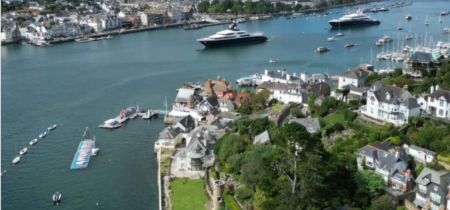
‘Jester’ holds court in the River Dart!
I received a message one morning simply saying ‘Jester is in the river’!
Matthew, one of our river taxi drivers, had spotted her on his rounds and he instantly recognised her: “Out of the corner of my eye I caught the junk rig slipping silently up past the Lower Ferry and behind the boats on mid-stream moorings. As soon as the green hull and the familiar silhouette appeared from behind another boat I knew it was Jester.”
At first glance Jester is a beautiful, but unassuming, craft. Yet her history is anything but modest.
Famous for inspiring the Jester Challenge, this small powerhouse, a junk-rigged Folkboat 25ft, has navigated the high seas and oceans – however this time her owner Trevor Leek sailed her into the River Dart on a leisure visit.
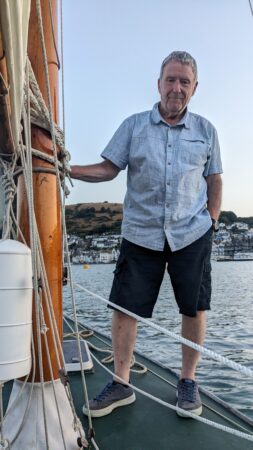
Trevor Leek on board ‘Jester’ in Dartmouth harbour
This ‘Jester’ is version two – she is an exact replacement after the original was sadly lost at sea during the 1988 OSTAR.
The new ‘Jester’ was lovingly constructed in 1992 after a trust was formed to build her replacement. And, as Trevor acknowledges, she is pretty much identical: “She is exactly the same – she was built by apprentices and they decided to display their skills by putting varnished mahogany planking on the replica, which wasn’t on the original, so I’ve painted it green, to return it as it was!”
According to the website, ‘the Jester Challenge, created for skippers of small boats who want to test their skill and self-reliance, is a uniquely successful experiment in single-handed ocean sailing’.
At the very centre of the challenge is, of course, ‘Jester’ herself.
Conceived by Blondie Hasler and built by Harry Feltham in Portsmouth in 1953, she has an unstayed mast and central control hatch from which all the operations are carried out, including the whipstaff steering and the rig lines, meaning there is no reason for the crew to go on deck. There are no guardrails and no outside space but, as Trevor says “I go up to tighten the steering lines if they’ve stretched”.
With no engine, there is a rotatable canvas dodger so the crew can look out whilst being protected from the elements.
“In extreme weather I have a sea anchor which I’ve deployed twice, which is difficult – I have to open the forward hatch with waves breaking over to feed it out.
“Regarding facilities on board – there aren’t any really! There is a paraffin stove, a bucket for obvious reasons – it’s all quite basic!”
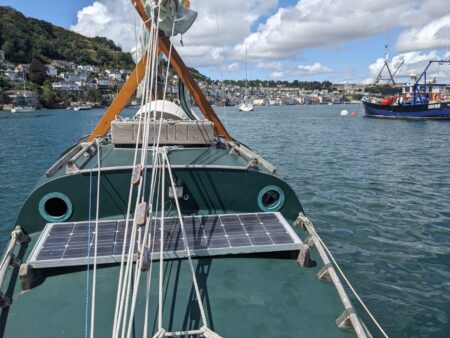
‘Jester’ sailing into Dartmouth
To publicise his design Hasler suggested a single-handed trans-Atlantic race – the first one ran in 1960, with Hasler coming second. This race transformed into the OSTAR (Observer Single-handed Trans-Atlantic Race) in 1968.
The Jester Challenge came into force in 2006 after the disenfranchisement of yachts under 30 ft from the OSTAR, with Ewen Southby-Tailyour being the driving force.
Trevor is a very experienced sailor, having taken part in two Azores and Back races (AZAB), two OSTARs and five Jester Challenges.
“I started sailing at age 24 after reading about, and being inspired by, ‘Jester’. I wanted to enter one of the OSTARs, so first took part in 1992 in the 28ft ‘Twister’, then again in 1996.
“My first OSTAR stands out in my memory because I’d fulfilled a dream. I won my class in the second OSTAR but the first one was better! It’s a great feeling!”
Having been inspired by ‘Jester’, Trevor’s custodianship was, as he and his wife said, “fate”.
“I had decided to have a break from sailing, due to work commitments. I then met a friend at a boat jumble in 2005 and she knew they were looking for a new owner for ‘Jester’ and my interest was piqued!
“I had to jump through some hoops – they were looking for the right person to carry on the ethos of ‘Jester’. Even though I knew Ewen, I had to go out sailing with Mike Richey (who took over ‘Jester’ from Hasler) in Plymouth and he had to be happy with me! I was fortunate enough to be chosen!”
Billed as ‘a modern experiment in old-fashioned self-reliance, self-sufficiency and personal responsibility’, the Jester Challenge is a transatlantic event based on Hasler’s original transatlantic race.
However, it is absolutely not a race. There is no time limit, no rules (only guidelines), no entrance fees, no timings and no prizes.
According to the Jester Helm, set up by Southby-Tailyour on his ‘retirement’ after 14 years, “the only rule is that there are no rules!”.
There are different routes running on consecutive years – a full Atlantic crossing from Plymouth to Newport, Rhode Island; the Azores route and a passage to Baltimore in Ireland.
Guidelines are simple – entrants have to be 18, self-funded, vessels must be between 20 and 30 feet (including multihulls) and power must only be via the wind or human.
Trevor welcomes both the ethos and community of the challenge:
“This ‘Jester’’s first OSTAR was 1992, in which I competed – she was being prepared in another boatyard so she wasn’t there with the other competitors at the start. By the time she arrived in Newport, I had set off back via the Azores.
“In this replacement I have done three Azores Jester Challenges and two Atlantic challenges, which were not completed. I have always gone the northern route over the Grand Banks but it just doesn’t work with this boat as she goes really badly to windward and the weather in that area has definitely changed.
“I was 350 miles north east of the Flemish Cap with a bad headwind. I tried to turn south to pick up better weather but it didn’t happen. I returned, still sailing single handedly, after 45 days at sea.”
Trevor’s sailing career hasn’t been without memorable experiences:
“There have been a few tricky moments and a few near misses. Returning from the 1996 OSTAR in a multihull, I was a week into bad weather going down wind, surfing the waves at 25 knots and I had 300ft of warp out to slow her down.
“Suddenly there were two massive whales heading towards me – their noses must have been level with the warp I was trailing. If I’d had a few more feet of warp out I would have been slower, which would have resulted in a collision with them.
“I had another whale encounter when I was drifting along at a couple of knots in the Azores and a whale came up behind me on the trimaran and showed a bit of interest in me!”
During the challenges skippers can make stopovers in other ports or harbours and can even retire one year and continue passage the following year.
Trevor has had to seek shelter himself and being in a recognisable boat can be beneficial:
“During the 2006 challenge I hit a storm about 500 miles west of Ireland and I didn’t have a working sea anchor and her sail was damaged. During my stopover in Oyster Haven a boat came out to meet me with two Irish guys on board and I could hear them saying ‘it’s Jester!’. They arranged a mooring for me, took me home and fed me!”
It is clear during the interview that Trevor probably wouldn’t want to do any of it in another boat – his ‘bond’ with ‘Jester’ and the Jester Challenge community as a whole is obvious.
“Everything about Jester is unique! The design by Blondie Hasler is incredible – he was an amazing engineer!”
And what are ‘Jester’’s and Trevor’s futures?
“I believe I have more challenges in me! I would like to enter Jester Challenges again, although I will do the southern route next time!
“Maybe I will do the Baltimore Challenge next year – I’ve never done that.
“At the moment I Just have a handheld VHF on board but I am thinking of taking a satellite communication system – my daughters are concerned for me!
“There’s amazing camaraderie and good humour during the events. It’s a really good community.”
‘Jester’ is based in Emsworth, Chichester, but Trevor obviously likes to get her out on the water to stretch her legs:
“I was accompanied by dolphins about eight miles off Dartmouth as I was arriving. I love Dartmouth! It’s sad I’ve waited 20 years to come back in ‘Jester’!”
The 2027 Jester Challenge is the Baltimore route in June, sailing sail single-handedly from Plymouth or Pwllheli to Baltimore, Republic of Ireland – a distance of about 250nm.
If you fancy taking part, please visit the website Jester Challenge – A modern experiment in old-fashioned self-reliance, self sufficiency, and personal responsibility.
View more news