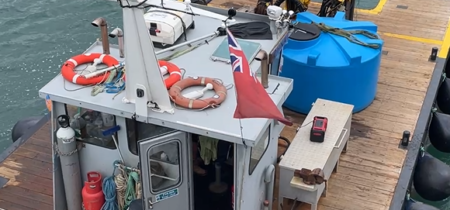
Main residential moorings
Dart Harbour has a wide range of berths available in all areas of the river. They are of the following types:
- Pontoon – alongside pontoon berths, may be island or walk ashore. Some berths have water and electric supplies.
- Swinging – traditional single buoy moorings that a vessel moors to over the bow
- Trot – fore and aft moorings between two buoys. These may be single – for one boat, or double, where two boats moor between the same two buoys.
Moorings are categorised based on depth
- Category A: Deep water - charted depth greater than 3m
- Category B: Mid water - charted depth between 1 and 3m
- Category C: Shallow water – charted depth under 1m
- Mud moorings: Dry out at each tide.
The use of these berths are assigned on an annual basis to berth holders. Typically berths will be assigned to the same berth holder each year, but it is not a right, as circumstances may mean that Dart Harbour needs to alter allocations. It is normally the case that all Dart Harbour berths are allocated, so a waiting list system is in place to allocate any berths that are not renewed – see below for details.
Dinghies & Tenders
Dart Harbour has pontoon, running and foreshore moorings, as well as dinghy racks for dinghies and tenders in various locations. These are mainly restricted to 4.3m in length and 2m in beam. Dinghy racks are restricted to 3.4m length and 0.7m moulded depth.
New berth holders will normally be assigned to the shallowest berth in the location, and ‘promoted’ to deeper water each season as other boats give up their mooring. When they are happy with their position, they can ask the Harbour office to fix their location.
Tenders
Vessels over 6m in length are allowed to have one tender of up to 4.3m length (up to 5.5m in length for a vessel longer than 15.3m), and may join a waiting list for a Dart Harbour berth or rack space for that tender – note that allocation of a main mooring does not automatically give a tender space.
Tender berths or dinghy rack space are not available to boats on walk-ashore pontoons or marinas. If boat owners on these berths want a dinghy then they will need to apply for a dinghy berth instead.
If a main mooring is given up, then the tender berth must also be given up. It is not possible for the tender berth to become a dinghy berth. It is also not acceptable for a customer to hold on to an empty main mooring simply to retain their tender berth.
Tender Prioritisation
Due to the limited space available for dinghies and tenders priority sometimes needs to be given to the provision of space for tenders. This priority will only be given in order to ensure that main moorings are not made unattractive and difficult to let due to not having space for a tender.
Prioritising tender berths in preference to making space available for dinghies can however cause a number of issues – in particular excessively long waiting lists for dinghies, and people hanging on to main moorings purely to keep the associated tender mooring. Dart Harbour will therefore constantly monitor the waiting lists for dinghy and tender berths in each location and adjust the weighting as necessary to ensure tender or dinghy berths are not being over or under prioritised. An efficient, low cost yacht taxi service is also maintained in the lower reaches of the river in order to reduce demand for tender berths.
Dart Harbour running moorings
Uniquely for Dart Harbour Moorings, many of these moorings are let as annual licenses without tackle. The mooring licensee must therefore supply and maintain their own tackle, and ladder where necessary. They must ensure that the mooring tackle is adequate for the task, and is kept in good condition. The mooring must be used correctly to prevent inconvenience to neighbouring berth holders, in accordance with the procedure located on our website. The berth holder is responsible for any public liability related to the mooring and ladder, and should maintain them appropriately and consider holding appropriate insurance. Mooring licenses may be revoked if the tackle and ladder are not well maintained. Otherwise, the requirements and procedures for a running mooring are identical to regular residential moorings.
Short stay dinghy moorings
Short stay moorings for dinghies and tenders are available in various locations around the harbour. These are available for a short stay of up to 6 hours free of charge, for dinghies up to 5.5m who have paid or are exempt from harbour dues. From 2023, longer stays up to 7 days are available on some of these pontoons on payment of a daily fee. Boats may be towed away if they are too large for the berth or overstay, and a recovery charge made. Dinghies should be secured on a single long line on the bow, so that the berths are not blocked. If the boat is locked to a cleat with a padlock or chain, the owner should be aware that Dart Harbour may need to cut the lock if it is necessary to move the boat. Outboards should be lifted as many berths dry at low water, and a bucket placed over the propeller to prevent damage.
Visitors Moorings
Dart harbour has a range of moorings available for visiting boats of all sizes. Visiting boats are always welcome, and Dart Harbour will do our best to find suitable berths for any visitors on a first come, first served basis.
Large & commercial vessels
Due to limited berthing options, Vessels of over 18m in length may reserve a berth up to 24 hours in advance, subject to availability, on full advance payment, by calling the harbour office.
Rallies and other events
Rallies of 8 or more boats are able to pre-book berthing, on pre-payment of 50% of the anticipated fee. There is a discount on mooring fees for rallies of 8 or more boats.
Longer and repeat stays
A ‘Frequent visitor’ harbour dues rate is available, that allows up to 90 days stay in the river for less than the cost of 14 nights at daily rate. Please note however that visitors paying this rate are not guaranteed moorings At busy times Dart Harbour may move longer staying boats away from prime moorings to ensure that there is space for those staying for shorter periods.
This welcome is also subject to the boat remaining as a genuine visitor i.e. sleeping overnight on a boat with accommodation or using a day boat on a daily basis – the following section details the restrictions on visitor moorings being used as de-facto permanent moorings.
Visitors laying up
To encourage visitors, Dart Harbour keeps visitor mooring prices low. In some circumstances, this means that boat owners try to use a visitor mooring as a long-term mooring, for example keeping the boat on the mooring for several months, but only visiting it at weekends, or becoming a liveaboard boat on a visitor pontoon. This is not normally acceptable, particularly in the peak summer months, as it ties up moorings needed for genuine visitors. Outside of the summer season, or in the case of special circumstances such as illness the Harbour Master may allow an extended stay or a vessel being left without crew on a case-by-case basis, for which a special higher rate is charged, and the boat must use DW3 pontoon.
Use of residential berths for visitors
Dart Harbour has historically used residential berths for visitor mooring, particularly for longer staying visitors. With the increase in visitor facilities, this should no longer be needed, other than at extremely busy times such as Dartmouth Regatta. The previous practice of offering a discount for freeing up a mooring will therefore be discontinued, though it may be offered on occasion by the Harbour Master at his discretion.
Liveaboard vessels & House boats
Unlike many harbours and marinas, Dart Harbour does not ban liveaboard vessels. We note the useful nature of having eyes and ears out on the water on a daily basis, and that for many of our customers this is the only home they have. However, we have added stricter requirements for liveaboard boats to have and use a holding tank, described in the requirements for a mooring section, on the basis that the toilets on these boats get more use than on less regularly used boats. Liveaboard boatowners remain subject to the rules to keep their boats well maintained, for them to be able to be lifted out of the water on the Dart, and that the boat must be mobile under its own power – house boats are not allowed. In addition, the rules regarding anti-social behaviour should also be noted – our moorings are principally for leisure use, and the presence of live aboard residents must not detract from the need for quiet enjoyment of their boats for other boat users. Using of boats on Dart Harbour moorings for Air B&B type or other holiday lettings is not allowed.
Commercial Moorings
A number of moorings on the river are dedicated for use by commercial vessels. In addition, the Harbour Master may, at his discretion, give priority to commercial vessels on the waiting lists for leisure berths. Priority will not normally be given to commercial vessels on DA, DB, LWL or KQ-KX pontoons, unless there is a specific reason that means no other mooring would be possible – in these locations a berth will be assigned in line with the timeline for leisure boats. In either case, a commercial mooring is let for the use of the business, and so it cannot be transferred to a leisure vessel or a commercial vessel used primarily for leisure purposes. Should the business (or that part of the business which requires the moorings) be sold, then the mooring must also be transferred to the new owner. The business must, in the opinion of the Harbour Master, be genuine and viable, both at the time of the original mooring application, and at all other times, including if the business is sold. In determining whether the business is genuine and viable, the following will be amongst the factors considered:
- The business is a source of income for the owner. The owner has presented accounts, or a detailed business plan to the harbour master, detailing its viability
- The business either has employees or the owner spends at least 500 hours per year working for the business.
- The business / vessel has appropriate commercial insurance including 3rd Party liability and wreck removal, to appropriate levels considering the type and size of vessel.
- The vessel is appropriate for the commercial activity. For vessels over 7m, this will normally include the need for coding or a fit for purpose certificate.
- The business has a website, and / or advertises its services and/or has a contract to provide services if appropriate
- The vessel is in regular commercial use. If it is also used for leisure purposes, this should be a small element of its use.
- The business is appropriate for the Dart.
Commercial moorings are normally allocated to one specific vessel and may not be sublet. Certain businesses require a holding mooring that will be used by multiple vessels over the course of the season – for example a mooring being used for display of vessels for sale, a waiting mooring for access into a tidal boatyard, or for repair of vessels by a shipwright. This is acceptable with specific written permission. The mooring holder must ensure that only appropriately sized vessels use the mooring, and it is not acceptable to sublet the mooring on a long-term basis.
Visiting commercial vessels
Dart Harbour has various moorings that are suitable for commercial vessels up to 200m in length. Commercial vessels may make advance reservations for moorings without advance payment, subject to availability. There is priority for local operators on outside Town Jetty between 08:45 and 17:00, other than the cruise ship tender berth. Other than this, reservations are taken without priority, based on the date of confirming the reservation. Specific berth allocation may be changed depending on other vessels making a booking.
Preferential space
A number of locations are allocated for commercial vessel landing. Preferential agreements may be made on these berths at the discretion of the Harbour Master, giving a commercial operator priority on a berth, either permanently or for a particular time period. Other operators are still able to use these berths for landing for short periods, providing it does not impede the priority operator. Longer stays may be possible by negotiation with the harbour master, who will consult with the priority operator to ensure that their operation is not affected.
Club safety boats
Yacht / rowing / sailing / boating club safety or workboats are treated as commercial vessels for the purpose of this section. This applies to clubs with a significant membership, and for an appropriate number of safety boats for the size of the club – typically one or two.
Private Tackle Moorings
This section applies to moorings where the mooring gear / tackle is owned by a party other than Dart Harbour. The right to lay and use a mooring within the harbour depends on two essential premises:
- The permission of the owner or lessee of the fundus or foreshore where the mooring is to be placed
- The consent – in the form of an annual license – of the harbour authority. This is required regardless of the ownership of the fundus
A license to lay a mooring is a bare license and is not an assignable property right. As Dart Harbour does not own the mooring tackle, these moorings should be referred to as private tackle moorings. These licenses require annual renewal – from 1
st April to 31
st March. On rare occasions Dart Harbour may need to move private tackle moorings on Dart Harbour fundus to a new location. These moves will be kept as small as practicable, and the move will be made at Dart Harbour’s cost.
Licensed Private Moorings on Dart Harbour owned or leased Fundus
These moorings are long established, the vast majority pre-dating the formation of the Authority. These are licensed annually by the Authority and a small charge is levied for this. When private moorings fall into disuse or the mooring holder gives up the licence or dies, licences will not normally be reissued. The tackle is returned to the owner (or the owner is compensated for it) and the fundus is cleared. The Authority may then decide to lay a new mooring and let this to the next person on its waiting list, or to a near relative of the deceased as described in the transfer of moorings procedure below. These moorings may not be sublet.
Licensed Single Commercial Moorings on Dart Harbour owned or leased Fundus
These moorings are long established, the vast majority pre-dating the formation of the Authority. These are licensed annually by the Authority and a small charge is levied for this. If the business is sold then the authority will not unreasonably object to the transfer of the use of the mooring to the new owner of the business. If the business should cease to operate as a viable genuine business (as described in the commercial moorings section), then the mooring will return to the authority – it would not be eligible to become a private mooring for the previous owner of the business. These moorings may not be sublet.
Licensed Private Moorings on Privately Owned Fundus
- These moorings are largely associated with riverside properties. The Authority issues an annual licence for each mooring and requires details of the boats using the moorings. The right to lay moorings in this situation is covered by the 1975 DHNA Act of Parliament and the issue of moorings’ licences is not automatic but, subject to safety, navigational and environmental considerations, the issue of a mooring licence (or licences) for a swinging mooring for the use by the owner will not be unreasonably withheld. A running mooring license for a mooring on private foreshore attached to a property to which there is no public right of access will also not be unreasonably withheld.
- Dart Harbour will not normally support applications for private pontoons on the estuary. Pontoons that are publicly accessible, or used by commercial businesses, or are temporary structures for a specific limited period may be considered on a case-by-case basis. Pontoons connected to the shore will require planning permission from South Hams District Council, and all works below mean high water require a license from the MMO.
- Mooring licenses are transferred to the new property owner on the sale of the property.
Mooring Businesses, on Dart Harbour owned or leased fundus
There are a number of commercial mooring businesses, apart from the Authority, who provide such moorings on a commercial basis. The Authority licences these moorings on an annual basis. These moorings can be sublet to other boat owners – the mooring business should provide Dart Harbour with details of the vessel and its owners. The use of these moorings is granted to the business, and should the business (or that part of the business providing moorings) be sold, then permission to transfer the use of the moorings as a whole to the new owner of the business would not be unreasonably withheld. Where practical, Dart Harbour will work with mooring businesses over time to ensure that lines of trots are managed by the same party. This may mean swaps of moorings, or private moorings reverting to commercial mooring businesses when they are given up by existing users.
Mooring Businesses, on privately owned or leased fundus
These include marinas and commercial mooring businesses on fundus outside of Dart Harbour’s ownership or lease. The Authority issues an annual licence for each mooring. These moorings can be let to other boat owners – the mooring business should provide Dart Harbour with details of the vessel and its owners. The right to operate these moorings would typically pass with the sale / lease of the fundus. Permission should be sought from Dart Harbour for any changes to mooring numbers or arrangements. Such permission will not be unreasonably refused, however full consideration will be given to navigational safety, environmental issues, local conditions, other moorings in the area and the character of the area as per the Port Master Plan, which may provide reasonable grounds for refusal.
License fees for private tackle moorings
A small fee is charged for licenses for a private tackle mooring. This covers administration, and the need for the authority to patrol the mooring to ensure it is in good condition and does not present a safety hazard to other river users. In addition, for moorings on Dart Harbour Fundus, there is a small annual Fundus rental charge.
Anchorages
There are designated anchorages in Dartmouth Harbour – east of the mainstream buoys; south of the Anchorstone, off Higher Gurrow Point, off Dittisham Mill Creek, and off Bow Creek. Vessels may anchor for short periods (less than 24 hours) outside these areas providing that they do not impede the main channel or other moorings, do not cause any damage to the environment, and obey any instructions of harbour staff.
Vessels at anchor must:
- Display the appropriate lights, shapes or signals
- Be capable of weighing anchor without assistance, and moving at notice appropriate to the conditions (not more than 24h in any case)
- Be mechanically sound
- Not anchor so close to any mooring or buoy so as to make contact or foul the mooring. This includes the ground gear from the mainstream moorings as per the chart, which intrudes in the mainstream anchorage
- Not anchor in the vicinity of the Higher Ferry, or interfering with any cross-river ferry route.
- Skippers and sufficient competent crew must be onboard for the first turn of the tide after anchoring, and are not to leave the vessel until they are certain that the holding is good, and the swing of the vessel will not interfere with other vessels, moorings, buoys and pontoons.
- The vessel must not be left unattended when inclement weather is present or forecast, or when the tidal stream may make the anchorage unsafe.
- The vessel must not be left unattended overnight.
- The vessel must not remain at anchor within Dart Harbour for more than 4 weeks in any 8 week period.
Vessels at anchor do not pay any berthing fee, but must pay harbour dues as required. Vessels that have been anchored unsafely, or otherwise not complying with the above conditions may be removed, and a charge made.
Vessels moored on beaches and alongside quays, walls and banks
In a tidal estuary, beaches, quays, walls and banks can be unforgiving places to moor a boat, with the risk of damage to boat or bank, particularly during storms. These locations are not therefore moorings for the purposes of section 33 of the DHNA Act 1975, as confirmed by a High Court Judicial Review in 2003. Dart Harbour will not normally allow berthing alongside any quay, wall or bank where the fundus or foreshore directly under the vessel is owned or leased by the authority, other than short stay berthing on those quays or moorings specifically dedicated to the purpose, or as described below.
Foreshore landing
Landing is allowed on Dart Harbour owned or leased foreshore (between high and low water) by small craft of up to 6m in length where:
- There are no alternative nearby moorings that would be more suitable
- There is no possibility of pollution or damage to fragile habitats, such as Saltmarsh, or disturbance to wildlife
- The vessel does not cause an obstruction to navigation or public access
- There is either:
- Public legal access to the site from the shore, by a public or permissive footpath or road, or
- The landing location is not within 50m of a private dwelling, or a boatyard, marina, farm, work site or other commercial location and the crew will remain in the vicinity of the boat below the high tide mark for the duration of their stay.
- No nuisance will be caused – this includes littering, loud music, use of BBQs or open fires etc.
- No attempt is made to go ashore off the foreshore, other than on a public right of way, or with the permission of the landowner
- The boat remains at the location for no more than 6 hours. Permission for longer stays is at the discretion of the Harbour Master. Overnight stays are allowed at Ashprington Point in connection with booked camping.
- There are no more than 3 other boats landing in this location. Short stays by a single group of more than 4 boats are acceptable if they do not cause a nuisance.
- The vessel is appropriately secured so it will not float away, but not using a lock or other system such that Dart Harbour cannot move it if necessary.
There is no charge for landing on foreshore, provided that the above rules are followed, and the vessel has paid harbour dues where appropriate.
Boat owners should note that much of the foreshore on the Dart is not owned or leased by Dart Harbour, and in these locations the foreshore owner’s permission must be sought before landing.
Dittisham Mill Creek Foreshore
This applies to the area of Dart Harbour Fundus located to the east of the footpath down to the creek. These moorings are rented for the winter season only, and must be vacated by 1
st April. As from winter 2023-4 these moorings are allocated as winter moorings in a similar way to all other moorings, so must be applied for and an administration fee paid before they are assigned for the winter. This is to prevent the historic situation where very poor condition boats have been dumped on this foreshore. The boat owner is responsible for laying their own ground tackle, that must be adequate to the task, and kept in good condition.
Private Fundus
Berthing at private quays where the quay owner also owns the fundus or foreshore, and on privately owned foreshore is allowed at the permission of the fundus owner, provided the vessel does not cause a navigational issue, cause pollution or damage to habitats, cause a nuisance, or deteriorate in condition.
Accessible moorings
Dart Harbour currently has very limited accessible berths. Customers with particular needs should speak to the Harbour Office to see what options may be available. Dart Harbour is able to make reasonable adjustments to ensure that people with disabilities are not discriminated against in provision of moorings. We are intending to improve access to our pontoon berths in the near future.
Multihulls
Residential moorings
Multihulled vessels are allowed to use Dart Harbour moorings, with no additional charge, however boat owners should be aware that many moorings are not suitable. Certain moorings have beam restrictions.
Visitor moorings
Multihulled vessels are allowed to use Dart Harbour moorings. At busier times the mooring allocated may be restricted, and a higher charge will be made.